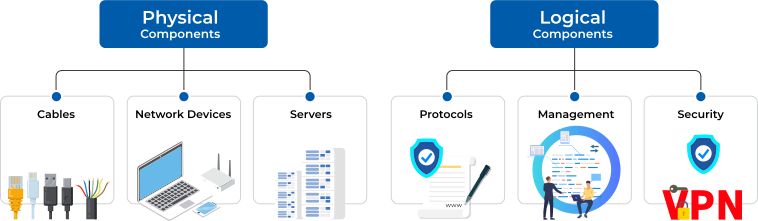
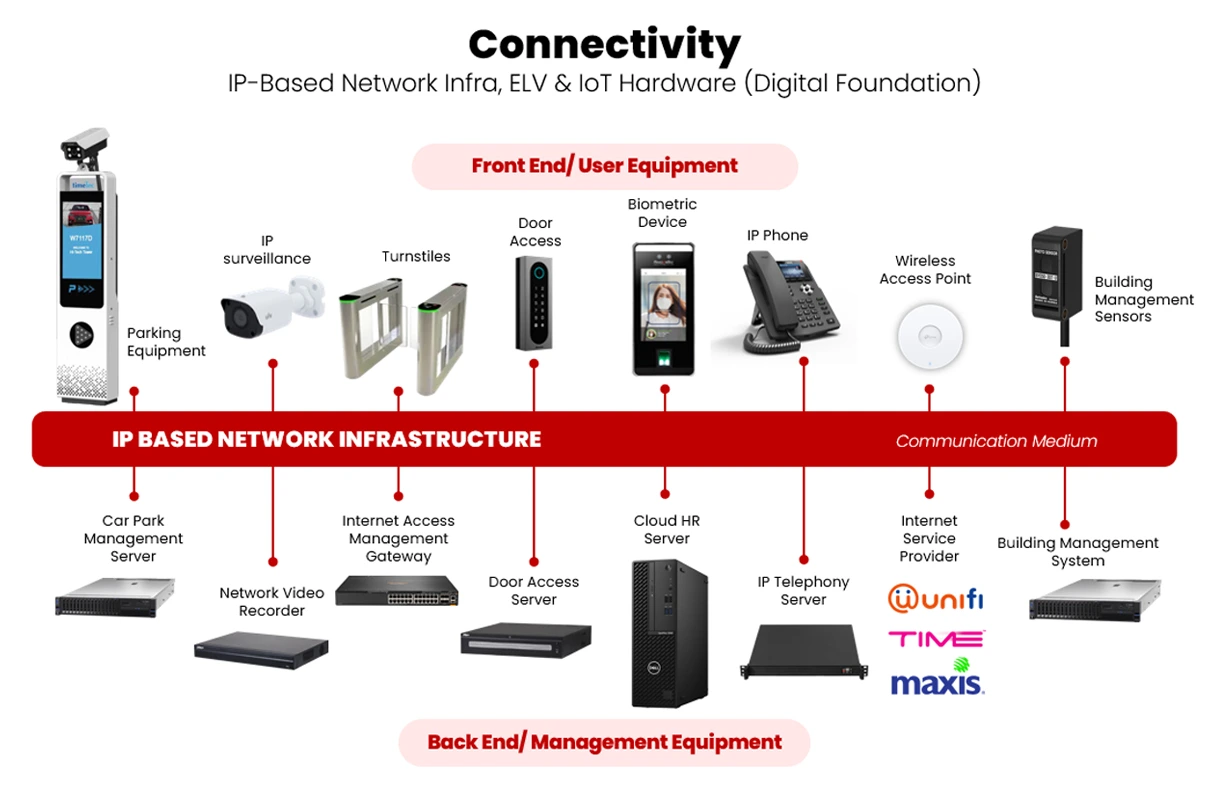
TimeTec offers complete Network Infrastructure solutions alongside our comprehensive PropTech ecosystem, delivering seamless connectivity to support smart building operations. From structured cabling to high-performance network equipment, our infrastructure services are designed to integrate flawlessly with TimeTec’s PropTech solutions—including smart access and elevator control, ELV & IoT automation, smart cashless and touchless parking, visitor management and etc., ensuring a reliable, scalable, and future-ready environment for modern commercial and residential buildings.
What Is a Well-Designed Network Infrastructure?
A well-designed network infrastructure is essential for any organization that relies on technology to operate effectively. It provides the foundation for integrating emerging technologies and new applications, allowing businesses to remain agile, up-to-date, and competitive in their industries.
For service providers, building a robust network infrastructure means ensuring scalability, high availability, and intelligent load balancing. These elements are critical to maintaining seamless connectivity and reliable system performance—key factors in today’s fast-paced digital environment.
Since network interruptions can never be entirely avoided, it's also vital to adopt streamlined network architectures and automated management tools. These help network administrators quickly identify, isolate, and resolve issues, minimizing downtime and ensuring optimal network functionality.
In the bustling city of Technovia, where skyscrapers shimmered with LED-lit circuits and the hum of innovation never ceased, lived a young engineering student named Aria. Her dorm room was cluttered with resistors, breadboards, and a well-loved copy of VHDL Analysis and Modeling of Digital Systems —a textbook she had inherited from a mentor but hadn’t yet cracked open.
On the eve of the project deadline, Aria uploaded her final design. The traffic lights blinked in perfect rhythm—red, yellow, green—and even responded to a pedestrian override button she’d added as a bonus. She wept. Not just from relief, but from the joy of seeing her code come alive. The textbook, once a dense wall of technical jargon, now felt like a trusted companion. Navabi’s emphasis on modeling and simulation as a feedback loop had paid off; each failure had taught her more than any lecture.
Aria’s goal was simple: to design a smart traffic light system using VHDL, a project deemed “optional” by her professor but essential for her to prove herself. She had always struggled with coding, but her love for solving tangible problems kept her going. Her first task? To model the traffic light’s timing sequence using a finite state machine (FSM) in VHDL.
By the fifth day, her counter module was working, but the transitions between red, yellow, and green lights were erratic. She spent late nights sketching state diagrams on sticky notes, aligning Navabi’s examples with her code. Her breakthrough came when she realized she’d missed a priority condition in the case statement. “Of course,” she muttered, recalling Navabi’s warning: “State machines thrive on clarity, not shortcuts.”
Weeks later, Aria presented her project at the university’s showcase. Her mentor smiled and said, “Remember, the true power of VHDL isn’t in the syntax—it’s in the ability to model real-world complexity with precision.” Aria nodded, holding the worn textbook close. The journey hadn’t just taught her digital design—it had taught her that the path to mastery was paved with resilience, collaboration, and the patience to turn errors into insights. Why This Story? This narrative mirrors the struggles and triumphs many students face when learning digital systems. It highlights the importance of resources like Navabi’s book, which serves as a guide through the labyrinth of VHDL design, and the value of persistence in overcoming technical challenges. While the story is fictional, it reflects real learning curves and the transformative power of dedication to a subject often seen as intimidating.
Vhdl Analysis And Modeling Of Digital Systems Zainalabedin Navabi Pdf Repack Instant
In the bustling city of Technovia, where skyscrapers shimmered with LED-lit circuits and the hum of innovation never ceased, lived a young engineering student named Aria. Her dorm room was cluttered with resistors, breadboards, and a well-loved copy of VHDL Analysis and Modeling of Digital Systems —a textbook she had inherited from a mentor but hadn’t yet cracked open.
On the eve of the project deadline, Aria uploaded her final design. The traffic lights blinked in perfect rhythm—red, yellow, green—and even responded to a pedestrian override button she’d added as a bonus. She wept. Not just from relief, but from the joy of seeing her code come alive. The textbook, once a dense wall of technical jargon, now felt like a trusted companion. Navabi’s emphasis on modeling and simulation as a feedback loop had paid off; each failure had taught her more than any lecture. In the bustling city of Technovia, where skyscrapers
Aria’s goal was simple: to design a smart traffic light system using VHDL, a project deemed “optional” by her professor but essential for her to prove herself. She had always struggled with coding, but her love for solving tangible problems kept her going. Her first task? To model the traffic light’s timing sequence using a finite state machine (FSM) in VHDL. The traffic lights blinked in perfect rhythm—red, yellow,
By the fifth day, her counter module was working, but the transitions between red, yellow, and green lights were erratic. She spent late nights sketching state diagrams on sticky notes, aligning Navabi’s examples with her code. Her breakthrough came when she realized she’d missed a priority condition in the case statement. “Of course,” she muttered, recalling Navabi’s warning: “State machines thrive on clarity, not shortcuts.” The textbook, once a dense wall of technical
Weeks later, Aria presented her project at the university’s showcase. Her mentor smiled and said, “Remember, the true power of VHDL isn’t in the syntax—it’s in the ability to model real-world complexity with precision.” Aria nodded, holding the worn textbook close. The journey hadn’t just taught her digital design—it had taught her that the path to mastery was paved with resilience, collaboration, and the patience to turn errors into insights. Why This Story? This narrative mirrors the struggles and triumphs many students face when learning digital systems. It highlights the importance of resources like Navabi’s book, which serves as a guide through the labyrinth of VHDL design, and the value of persistence in overcoming technical challenges. While the story is fictional, it reflects real learning curves and the transformative power of dedication to a subject often seen as intimidating.