vs
In conclusion, the 500MB movie was a significant milestone in the development of digital media, marking a transition from physical media to digital distribution. While it has been replaced by more efficient technologies and formats, its legacy continues to influence the way we consume and interact with video content. As the digital landscape continues to evolve, it's essential to acknowledge the contributions of earlier technologies, like the 500MB movie, which paved the way for the modern streaming era.
The MPEG-1 encoding standard, which was widely used for 500MB movies, played a crucial role in achieving this compact file size. MPEG-1, developed by the Moving Picture Experts Group (MPEG), was designed to provide a good balance between video quality and file size. It achieved this by using lossy compression, which discarded some of the video data to reduce the file size. While this resulted in a lower video quality compared to modern standards, MPEG-1 was sufficient for the average user, and its widespread adoption helped to establish the 500MB movie as a viable format. 500mb movies
To understand the significance of 500MB movies, it's essential to examine the technical and socio-cultural contexts in which they emerged. In the late 1990s and early 2000s, the internet was still in its formative stages, with dial-up connections and 56k modems being the norm. Uploading and downloading large files was a time-consuming and often frustrating process. The 500MB movie, with its relatively small file size, became a sweet spot for video sharing, allowing users to distribute content quickly and efficiently. In conclusion, the 500MB movie was a significant
The rise of peer-to-peer (P2P) file-sharing networks, such as Napster, Kazaa, and LimeWire, further popularized the 500MB movie. These platforms allowed users to share and download large collections of music and video files, often encoded in MPEG-1. The ease of sharing and accessing copyrighted content, however, raised significant concerns about intellectual property rights and copyright infringement. The music and film industries responded by pushing for stricter copyright laws and more effective digital rights management (DRM) systems. The MPEG-1 encoding standard, which was widely used
Despite its decline, the 500MB movie still holds a nostalgic value for many who grew up with the early days of digital media. For some, it evokes memories of late-night file downloads, anxious waits for videos to buffer, and the excitement of discovering new content on P2P networks. However, as a technological artifact, the 500MB movie represents a stepping stone in the evolution of digital video distribution.
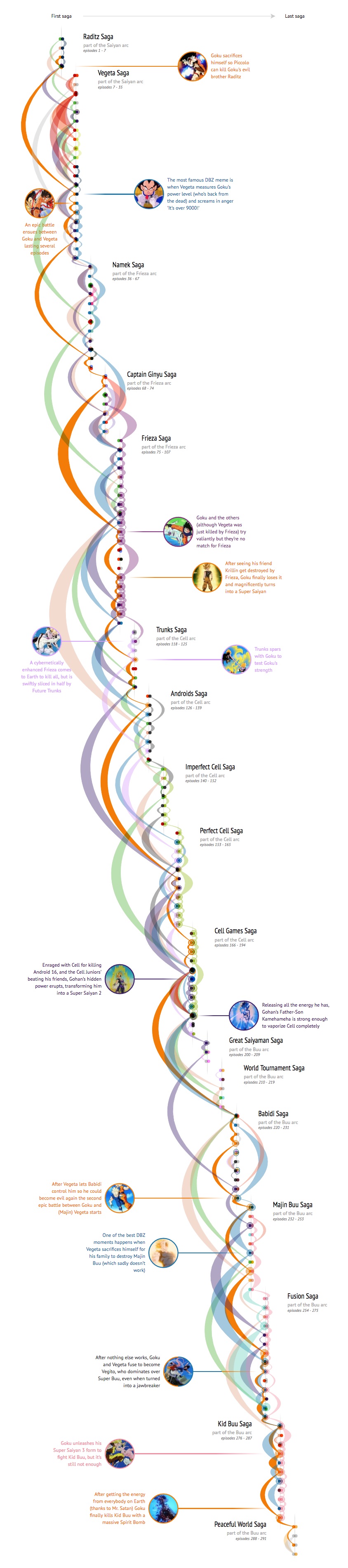
Extra interactivity on desktop The visual above is just an image, but on a large screen you see the full interactive and get the option to hover over each of the fights and character paths to see extra information about the fight; who was fighting whom, what was special about the fight and in what other battles did these characters fight.

Check it out behind your laptop / desktop as well for an even more detailed look into all fights that happened in Dragon Ball Z.
The fight info was taken from the Dragon Ball Wikia pages for each saga. For relevance, a few fights were taken out of the above visual; the Garlic Jr. and Other World Tournament filler sagas were completely removed. Also the ±5 fights that happened in the anime only and didn't feature any of the Z fighters, happened in a nightmare or flashback were taken out.
Created by Nadieh Bremer | Visual Cinnamon
Data from the very extensive Dragon Ball Wikia | Read about the design process in this blog